
A Metric for the Value of a Meeting
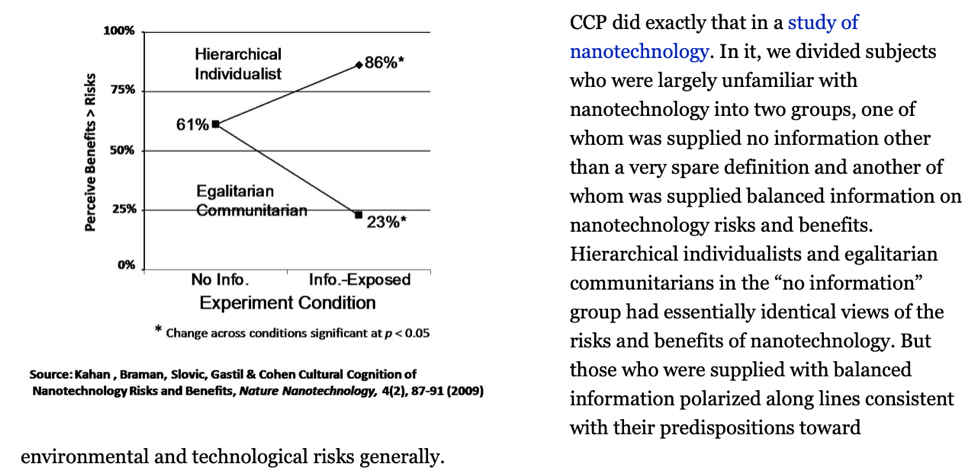
If you find yourself changing the first slide of your talk during the meeting it has been very worthwhile. The slide above is very similar to one that the keynote speaker used on Thursday. It is from work of Dan Kahan 14 years ago (100 years in IT years) and is similar to ones most of us not only know but use ourselves. For those of us in science education this work has the same significance as classical experiments like the Michaelson-Morley experiment. It upended our understanding (model) of our world – it contradicted our expectation that as people learned more they would tend toward the “right” position on a controversial topic. This is the scientific method in action. Experiments like these do not require multimillion dollar funding or a lot of expertise.
Science is a Verb not a Noun
Before my week at Space Camp, science was a noun, a subject, a collection of facts in a book loaned to me by my teacher, passed down from class to class and student to student, our names etched in ink on the inner cover. After Space Camp, science was a verb, a thing to do. (… Maria Fadri-Moskwik)
In the face of overwhelming odds, I’m left with only one option. I’m going to have to science the sh** out of this. (… Mark Watney in “The Martian”)
In the face of overwhelming odds, We’re left with only one option. We’re going to have to science, art and humanities the sh** out of this. (… Frank Wattenberg, SENCER SSI 2023)
Wonder
If I had to describe science in one word that word would be “wonder.” What does that word mean to you? For me the first meaning is “questioning” as in wondering how and why things work. The second meaning is a sense of “awe” about the world around us, how it works and how it came to be.
The Sciences, Arts and Humanities, All Working Together

Our eyes have three different color-sensing sensors – red cones, green cones and blue cones. Our digital cameras use the same three colors for sensors and our color displays emit the same three colors. The picture above uses this as an analogy for the sciences, arts and humanities. The upper left of the scene is taken through a red filter, the upper right through a blue filter and the bottom through a green filter. As you move toward the center we mix these three basic colors and in the center you see the full beauty of the scene in all its color – the same way we can only appreciate and understand our world using the sciences, arts and humanities all together.
Living as a Scientist, Artist, Humanist Everyday and Everywhere
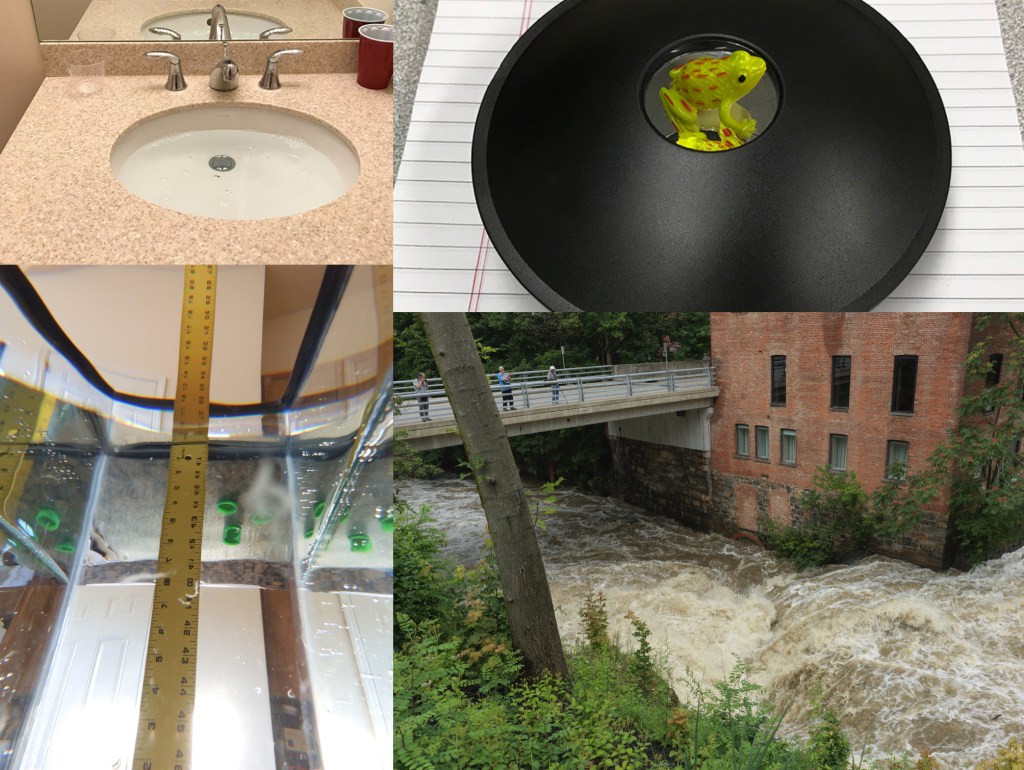
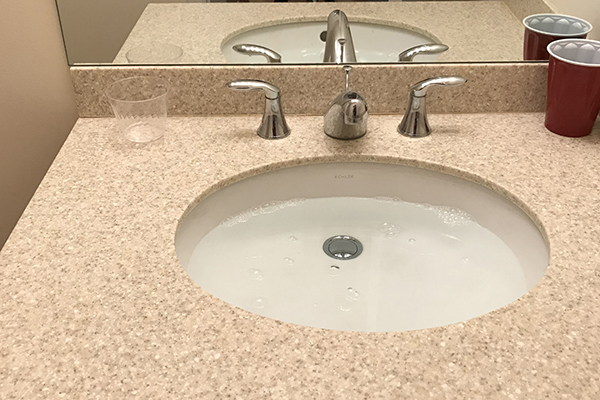
Use your mouse to drag the vertical bar back-and-forth in the figure below to see how refraction changes the apparent position of the drain in the bottom of the washbasin.

We want our students to live the life of a scientist – bouncing back-and-forth between theory/modeling (building mental models of the real world) and the real world (observing and experimenting). The example unit below illustrates this idea.
Example Unit — A Two-Day Unit — One Chapter in the Life of a Scientist — Ready to use
Modern (Smartphone) Photography
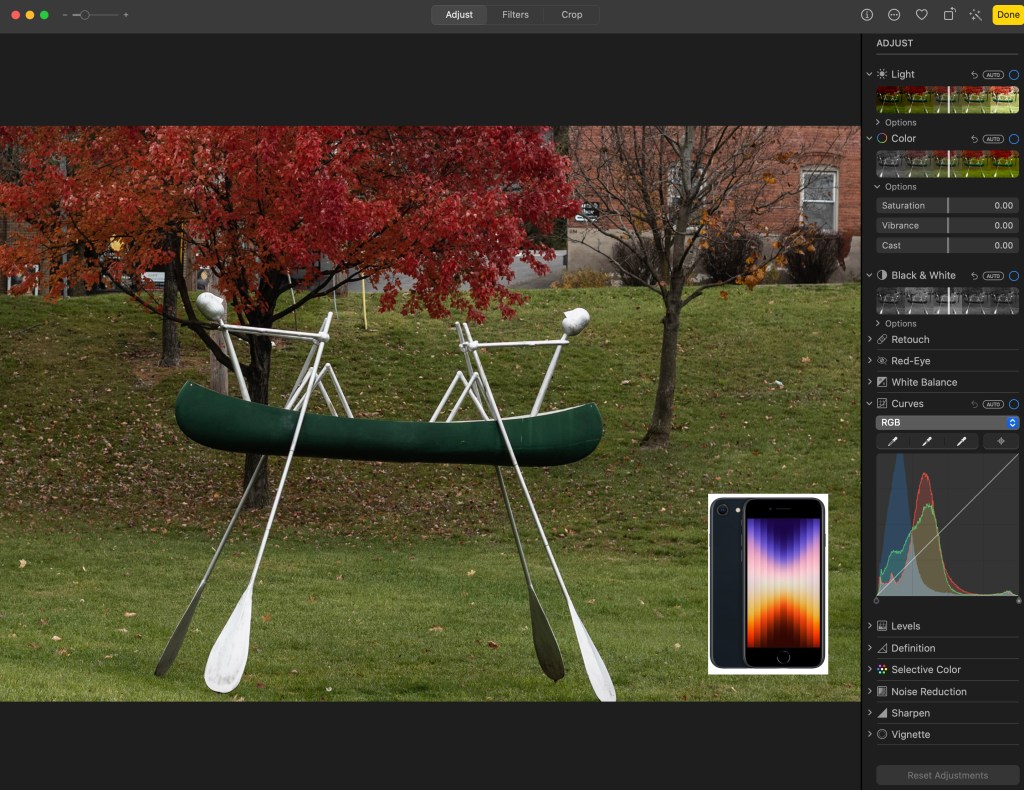
Modern Smartphones (for example, the Apple iPhone SE $429) together with free supporting software (like Apple’s Photos app) are incredibly powerful tools both for doing science and for expressive photography. They are the product of the sciences (mathematical algorithms, data analysis and artificial intelligence, optics and much more) and the arts. The image above shows the Apple SE added to a screenshot of a photographer editing a photograph in Apple’s Photos app. The photographer has all the power of Ansel Adams’ dark room and the most expensive and bulky view cameras. As one example, the photographer can correct for the distortion produced by shooting upward at a building. Using this power requires both artistry and an understanding of the algorithms available at the click of a button or drag of a mouse.
These smartphones are also powerful tools for doing science. As one example, the Apple SE can make slow motion videos at 240 frames per second and time lapse videos — and — these photographic capabilities partner with an array of sensors (for example, GPS) that collect more data. According to the Pew Research Center 96% of Americans aged 18-29 own a smartphone (April 7, 2021).
Perhaps most importantly, armed by the sciences and the arts and motivated by the humanities our students can use the analytic and expressive powers of modern smartphones to foster understanding across cultural boundaries and advocate for actions to improve our world.
A Small Part of a Conversation with ChatGPT 4.0
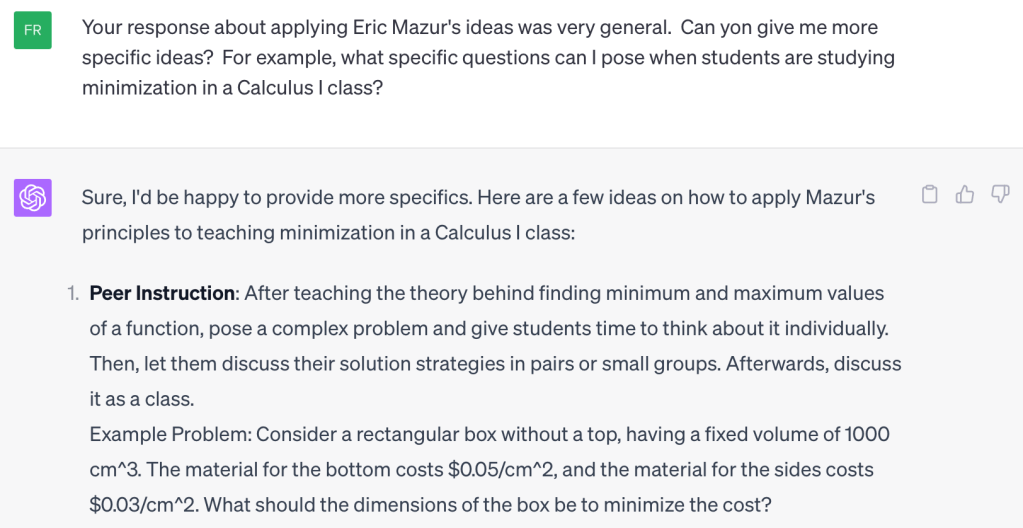
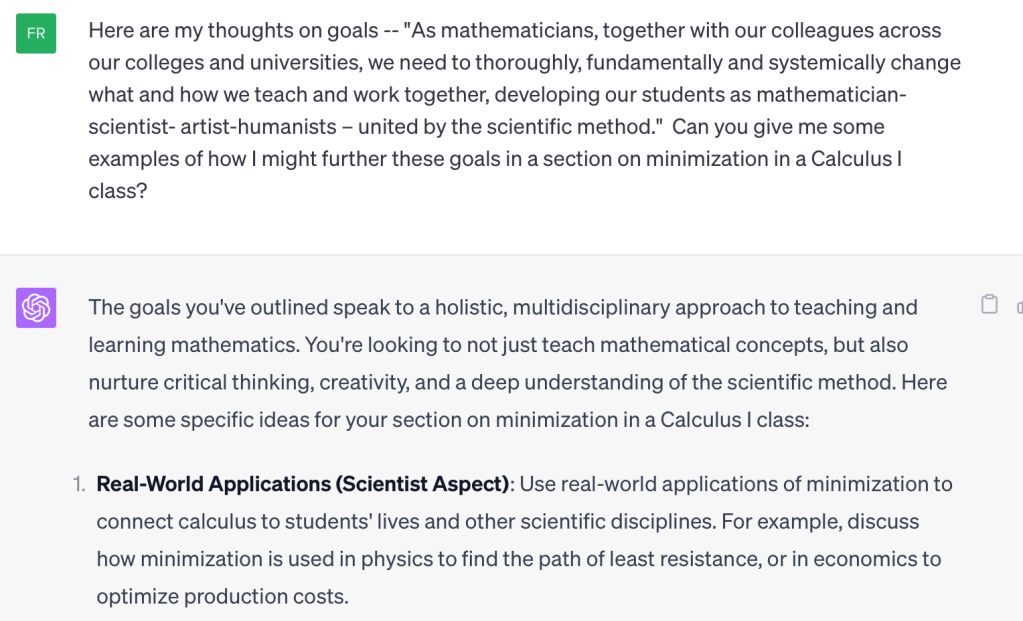
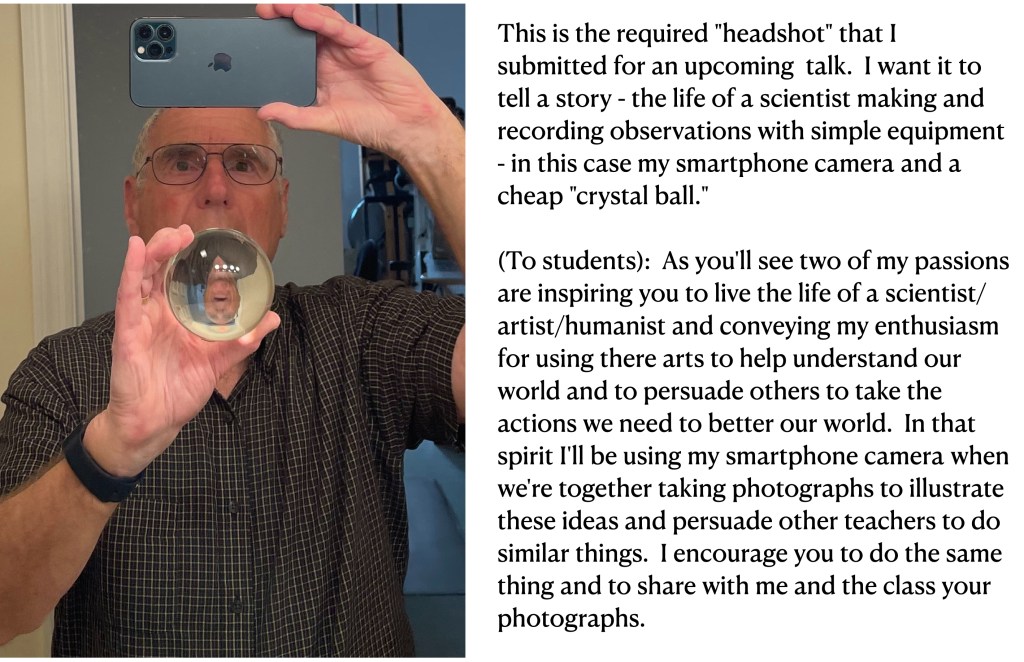
We need creative, passionate and purposeful people, not AI and not the existing “data sets.”


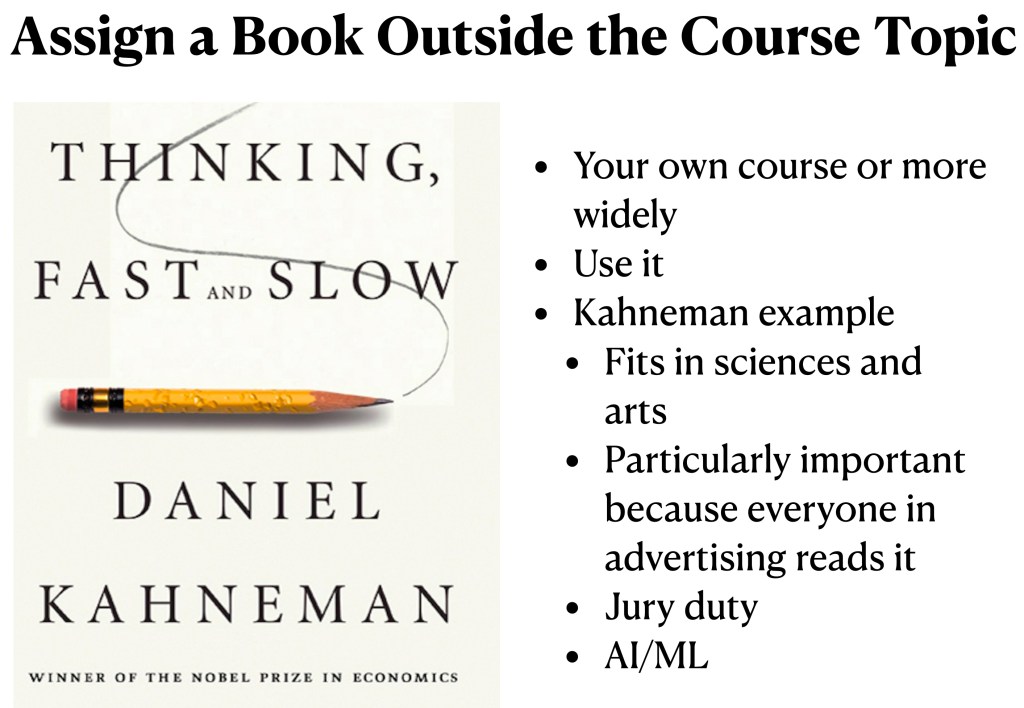
One high impact way to connect your own class with other classes and with the wider world is by assigning an “outside reading” book and using it in class. This is particularly effective if several courses or the whole school assigns the same book. One particularly good choice is Daniel Kahneman’s “Thinking, Fast and Slow.”
Extend and Share the Scientific Method
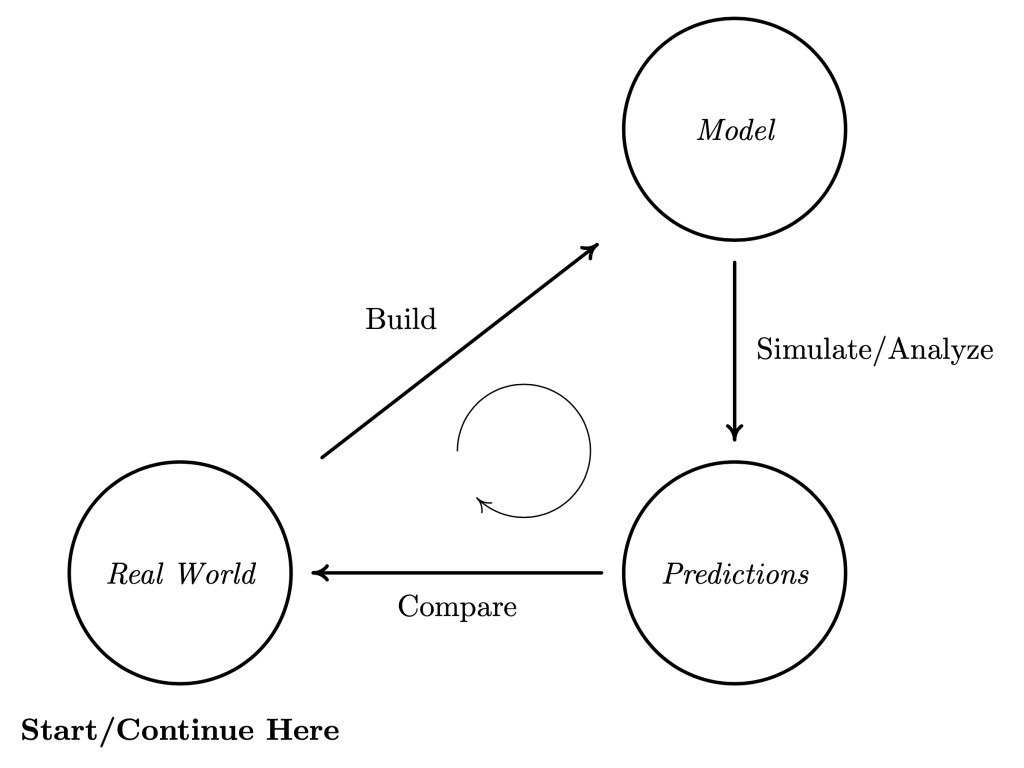
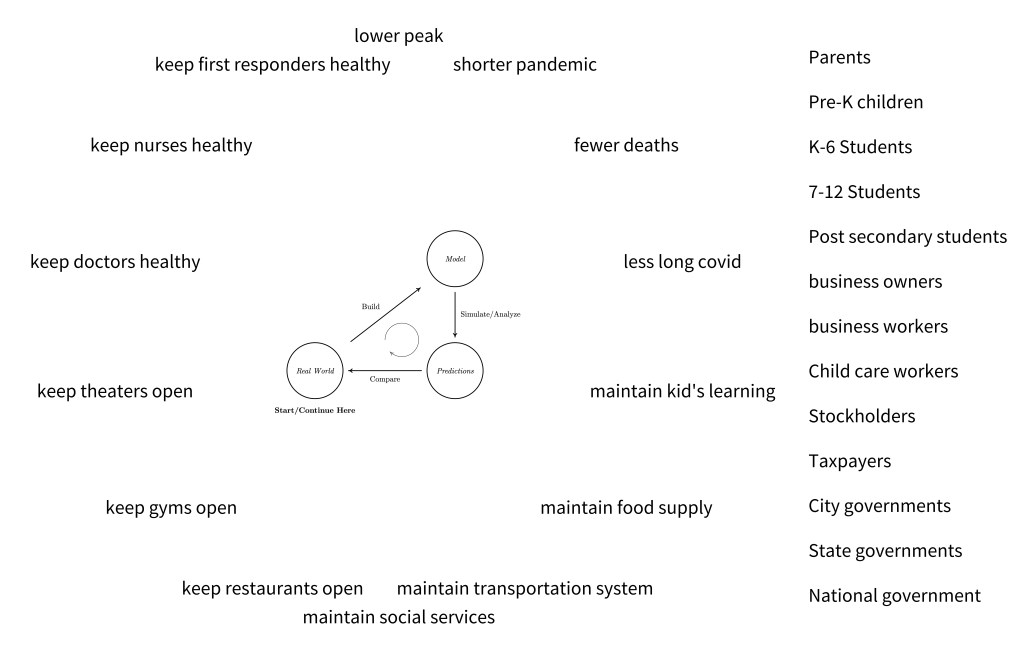
The diagram above can be used in a science class as a way of visualizing the scientific method or in a modeling class as a way of visualizing the modeling cycle. We can embed it in the diagram below to visualize the way that the scientific method interacts with and can be extended to high-stakes decision-making where multiple stakeholders emphasize different values or metrics for success. This extended diagram can connect the sciences, arts and humanities.
Revisiting ChatGPT 4.0
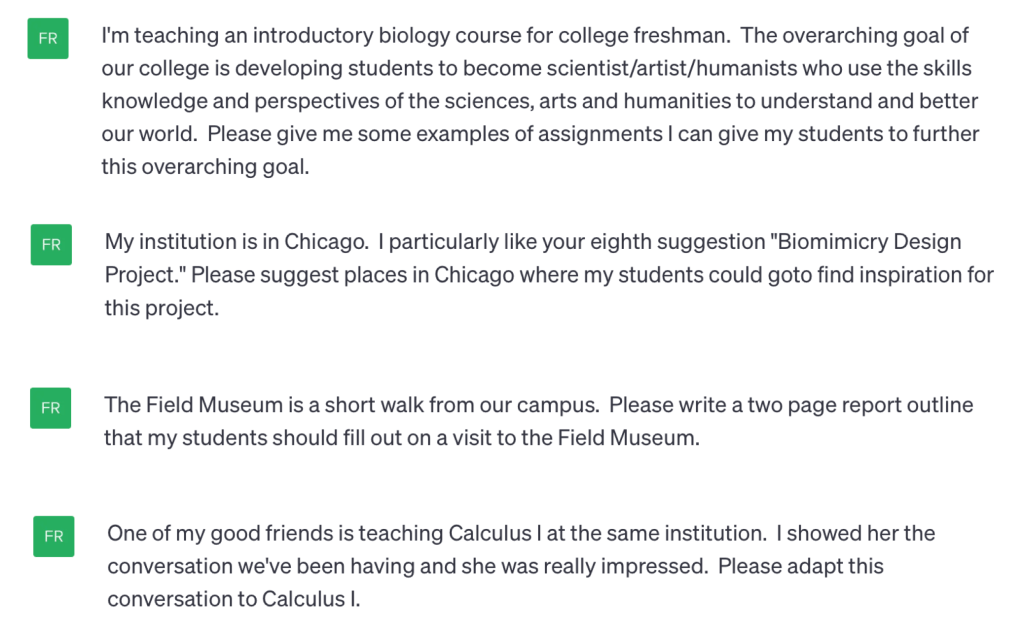
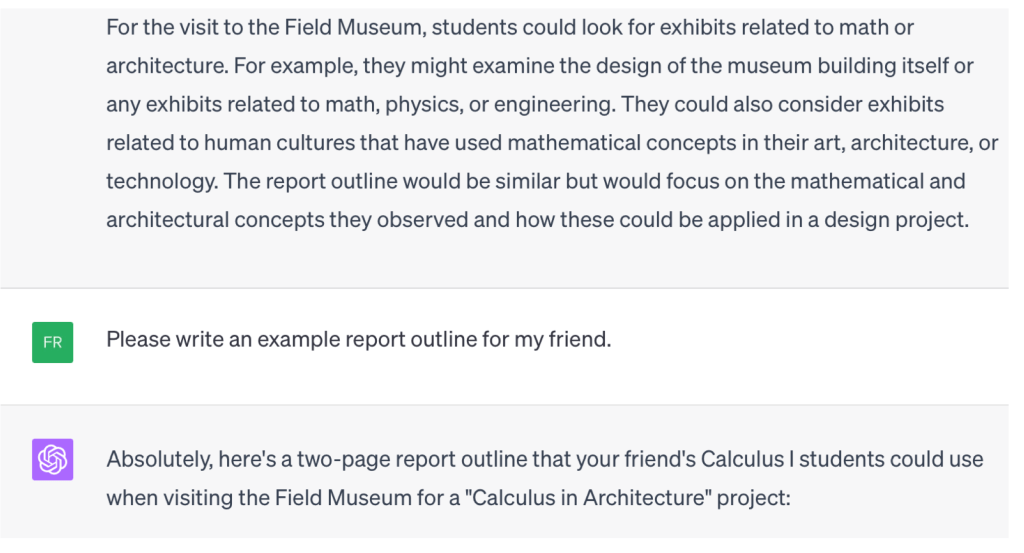
The conversation above is a much more interesting interaction with ChatGPT-4. It is one of many leading me to believe that we as science educators and civic activists can use ChatGPT-4 and to believe that our students can use it effectively. So I decided to change the title of this talk. If you haven’t conversed with ChatGPT-4 I highly recommend doing so and joining the conversation about its potential, limitations and dangers.
I also highly recommend this article for more insight into how ChatGPT-4 works https://arstechnica.com/science/2023/07/a-jargon-free-explanation-of-how-ai-large-language-models-work/
 Just Add Math