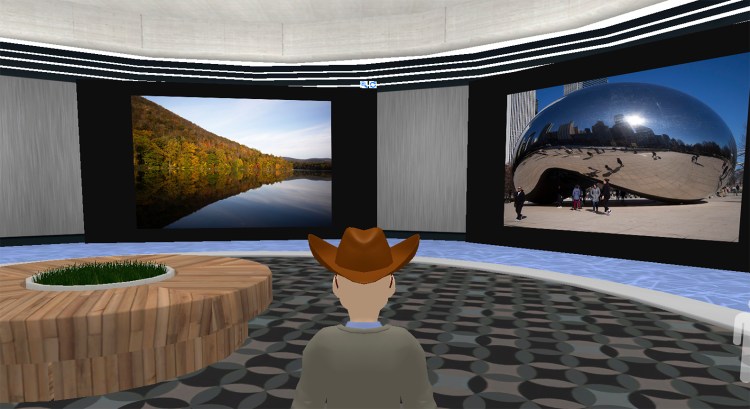
You will own your own art gallery and be able to create exhibits that others can visit. You will be able to visit other art galleries and you will be able to meet other people in your own gallery or other galleries. The heart of your exhibits is the images you arrange on the walls. Most of these images will be photographs and you should begin by taking an inventory of your collection of pictures and of your camera(s). You probably have a digital library of pictures, perhaps on your smartphone and you probably have at least a camera on your smartphone. You may also write short computer programs that can enhance your photographs in various ways. For example, suppose you have a picture of your class and want to shine a spotlight on one of the people in the photograph. You can do this with a bit of computer programming. See the two images below.


The most important benefit of having your own gallery is that your life will change. You will find yourself thinking about the ideas you want to share, the stories you want to tell, and the ways in which you want to change the world for the better. As you go about your life you will find yourself making photographs that you might eventually use in your art gallery. You may even find yourself making special trips to take photographs that might eventually find their way into one of your exhibits.
But you won’t just use images. You’ll be able to play music or other sounds in your gallery and you will almost certainly want to provide gallery notes for visitors to your gallery. Here is an example – gallery notes that I made for an exhibit about my life during the first six months of the COVID-19 pandemic.
Before You Start
Before you start creating exhibits and the mechanics of setting up your own art gallery, think about what you might want an exhibit to say. Pick a possible topic and your point-of-view. Here are some examples of topics:
- How the COVID-19 pandemic affects you.
- Your city, town, or neighborhood.
- Your home.
- Your job or school.
- Some of the people in your life.
- A typical day in your life.
Once you’ve picked a topic think about what you want to say, what you want other people to understand about the topic. For example, suppose your topic is your neighborhood. Think about a series of ten images you might use. For example, you might use an image of the main street in your neighborhood but different people walking down the same street see different things. For example, you might see an ice cream shop and think about eating ice cream cones with your friends. Perhaps, you might use a selfie with you and your friends eating ice cream cones on the street outside the shop. … or, perhaps you see overflowing cans of garbage waiting to be picked up. Pick photos that show what you see and that convey the emotions you feel. You may have many of the photos you need already in your digital collection but you will probably need to take some new ones. If you want to convey sad things wait for cloudy or rainy days but for happier thoughts wait for sunny days.
Our lives are rich and complex and so are the stories we want tell and the memories we build. As you go about each day, take lots of pictures and think about the different things you see as you stand in there same place. One day there might be pristine newly fallen snow and a few days later the dirty remnants of the same snowfall. On a hot day looking toward the street you might see backed up cars, spewing smelly fumes but looking away from the street you might see a flower box. Take pictures of the same trees – in spring with fresh light green leaves, in the fall with red and yellow leaves, and in the winter with bare branches. The pictures you take may enrich your memories and the stories you tell.
 Just Add Math