Mathematics and Science are all around us, in our homes, in our playgrounds, everywhere. For example, move the slider back-and-forth in the live figure below to see how filling a washbasin with water changes the apparent position of the drain at the bottom of the washbasin. This phenomenon is called refraction.

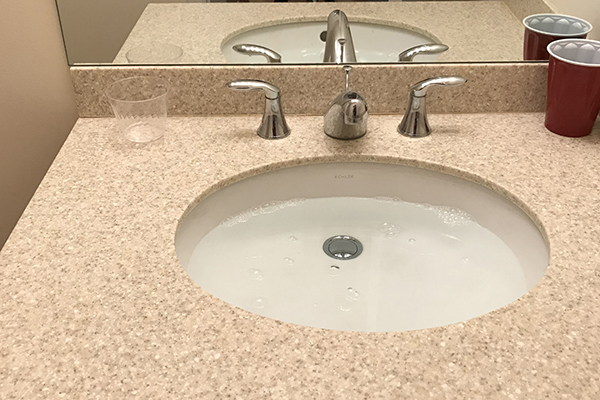
In this web site, written to accompany a workshop at the March 14, 2022 meeting of ICTCM, we play with three examples of everyday settings in which we can study mathematics and science in many different courses at many different levels from middle and high school through undergraduate college:
- Balance, equilibrium points, reversibility and irreversibility, and tipping points with paper clips. What we can learn from simple physics and math about climate science and the fracturing of our body politic.
- Optics in water glasses, washbasins, fishtanks and make-up mirrors. The power of simple geometry.
- The everyday, everywhere experimental power of cellphone cameras.
Our topic – everyday, everywhere mathematics and science – is particularly important at this moment in time. At the precise moment when the expertise of science and scientists is most needed to surmount challenges like climate change, pandemics and the fracturing of our body politic, many people distrust scientists. Scientists have been tarred by the broad brush of populist anti-elitism. This is due in large part to deliberate demonization and even intimidation by stakeholders who oppose science-based courses-of-action but it is also due into no small part to our own actions as math and science educators.
Bruce Alberts (who served as president of the National Academy of Science for 12 years) writes in Why science education is more important that most people think:
The COVID-19 pandemic has revealed that a shockingly large fraction of the public is willing to ignore scientific judgements on issues such a vaccines and mask wearing. For far too many, scientific findings are viewed as what scientists believe, rather than as the product of an elaborate community process that produces reliable knowledge. This widespread misunderstanding should serve as a wake-up call for scientists, clearly demonstrating that the standard way that we teach science – as a large collection of “facts” that scientists have discovered about the world – needs major change. Three more ambitious and important goals for science education at all levels are outlined. In order of increasing difficulty, these are: (1) to provide all adults with an ability to investigate scientific problems as scientists do, using logic, experiment, and evidence; (2) to provide all adults with an understanding of how the scientific enterprise works – and why they should therefore trust the consensus judgements of science on issues like smoking, vaccination, and climate change; and (3) to provide all adults with the habit of solving their everyday problems as scientists do, using logic, experiment, and evidence.
and Nobel prize-winner Carl Wieman in Education is about learning to make better decisions adds:
What education really needs to be about is knowing information in a way that you can use it and apply it to make better decisions in your life. The ultimate value of education is about learning to make better decisions. And every member of the public needs to have that capability and make good decisions about, for example, what they’re going to do in their life to be healthier, or create less pollution, and dealing with all of these important societal problems that we face that have some technical underlying principles in them.
Fundamentally, I see science as about learning to apply the relevant information to make decisions. That’s something that our studies say everybody can learn, and everybody needs to learn.
I see two big challenges in teaching science better. Firstly, the one that I already talked about: Students think they’re supposed to be learning a bunch of information, and not that they’re supposed to be learning how to make decisions in real world situations. That expectation of what learning is, and changing that expectation, is one of the big challenges, especially when I start thinking about, not just me teaching my own courses, but better teaching of science more broadly, at all grade levels. The first challenge is changing that old basic attitude and philosophy about learning science.
The second big challenge is the erroneous view that being good in science is an issue of talent, or in other words, some kind of special innate property of a brain. I understand why our societies tend to think that way, but our research, and that of many others, says it’s just completely wrong. We get students in our classes and some of them know more physics than others. But it’s all a matter of the educational privilege they have had, it’s not anything to do with innate talent. Same with Nobel Prize winners.
This workshop is based on the belief that our students and every person needs to not just understand but live the life of a scientist, working to make the best possible decisions in high-stakes situations that are characterized by uncertainty and rapidly evolving knowledge — decisions that typically involve working with several often-conflicting measures of success and where there are multiple stakeholders. The life of such a scientist involves lots of experimentation and observation, moving back-and-forth between our theories, or mental models, and the real world they are supposed to help us understand and improve.
Fortunately there are many things around your house and neighborhood that support this kind of experimentation and observation. In addition, your cellphone camera is a powerful tool for experimentation and observation. Coupled with apps it is also a powerful tool for analysis. Even better it is a powerful tool for expression. In particular, you can produce photographs and movies that convey the visceral cross-cultural understanding that we need to bridge the cultural divides that are rending our body politic.
The examples we discuss in this workshop are very different than the usual textbook examples. Instructors often value short discrete units that conclude with a summary of what has been learned. But our examples leave more questions than answers and students should write down not only what they have learned but also the questions and uncertainties that remain open.
Example 1
Paper clips and How to Tell When Your Country is Past the Point of No Return
In this first experiment we use paper clips to help understand concepts like “hysteresis” and “tipping points” that can help us understand and, perhaps, overcome the dangers posed by extreme polarization. There are two pdf files below. The first is for students (you should use this first as a workshop participant) and the second is for instructors (for use after the workshop).
Our next two examples, Example 2 and Example 3, are closely related. Example 2 is about optics. You can do amazing experiments with everyday “equipment,” like mirrors, water glasses and washbasins. The mathematics we need can be very simple – geometry and similar triangles – or more advanced – the ability to minimize a function using technology or Calculus. The results are often quite startling, a good place to see the interaction between the real world and theory.
Example 3 is about using your cellphone camera for observation, experimentation and, most importantly, for art. It may be no accident that our world is in the midst of several simultaneous crises at the same time that the STEMM disciplines (science, technology, engineering, mathematics and medicine) have been so strongly emphasized, often crowding out the arts and humanities. We need the arts and humanities to communicate the visceral cross-cultural understanding that is needed for us to work across cultural boundaries. In addition, the STEMM disciplines provide power but the arts and humanities provide purpose. An equation like e=mc^2 can power our homes or obliterate our cities and the “collateral damage” caused by social media shows the danger of power whose primary purpose is profit. The sciences on the one hand and the arts and humanities on the other are not opposed. In fact, they are synergistic. The sciences empower the arts – from the chemistry of pigments to modern day digital photography and virtual worlds. The arts power the sciences – from the Leonardo da Vinci’s anatomical drawings to modern day data visualizations.
Example 2: Optics, Fishy Experiments
This example tells a story about the interplay between experimentation and observation on the one hand and theory or modeling on the other. In short, this is a first person story about the life of a scientist.
Example 3: Everyday Cellphone Photography, Telling Stories with Geometry
 Just Add Math