Thinking, Fast and Slow – Daniel Kahneman and Others
The screenshot below is from Daniel Kahneman’s book “Thinking, Fast and Slow.” The book talks about two modes of thinking: One “fast thinking” occurs at lightning speed subliminally without conscious thought. It looks at a lot of information very quickly and makes connections. It often leads to actions that we describe with words like “instinctive,” “reflexive” and “intuitive.” Working by itself the “fast” mode can trigger rapid response – like fleeing a dangerous situation. The other mode, the “slow” mode, is more rational and linear. The two modes work together.
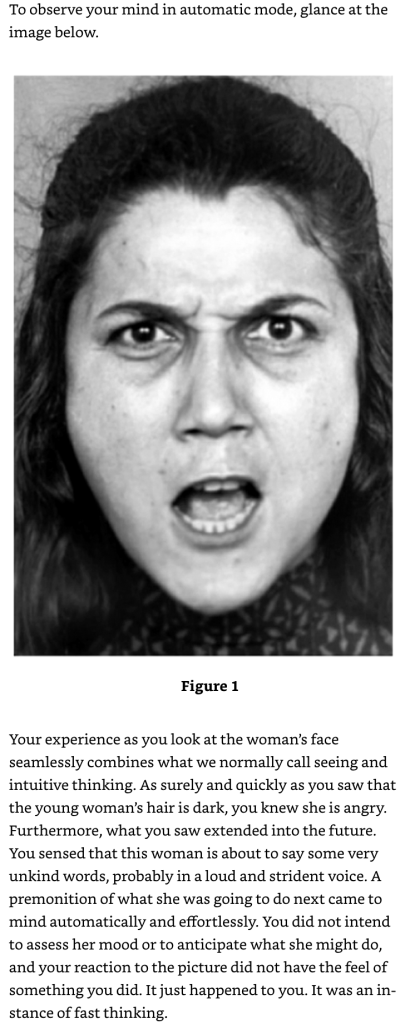
In this first part of the 21st century we have an explosion of both fast and slow thinking powered in large part by advances in Computer Science. Artificial Intelligence, extremely large data sets and machine learning give us as individuals and collectively enormous powers for fast thinking. Quantum technologies and quantum computing may kick this up another magnitude or two. At the same time, increased computational power and advances in mathematics give us far more power for rational, “slow,” thinking.
In addition, because of the synergy between the two modes of thinking, we can expect yet another increase in the power of thinking. As one example, modern cameras use “fast” thinking to do things like recognize people, pets and birds in flight to handle things like focus and exposure based on “slow thinking, more rational algorithms” and they free photographers to focus their own “slow thinking” on composition and perspective.
The guest essay Noam Chomsky: The False Promise of ChatGPT by Noam Chomsky, Ian Roberts and Jeffrey Watumull on March 8, 2023 in the New York Times is really good reading as we seek to understand the difference between and the interplay between artificial intelligence and natural intelligence.
 Just Add Math