In Scenes 3-8 geometric optics was remarkably successful even at explaining some unexpected and often counter-intuitive observations and experiments. Now we will do some experiments that show some shortcomings of geometric optics.
Our first experiment uses two props – the flashlight app on your smartphone and your hand. Use your smartphone flashlight app to make shadows your hand. You probably played with shadows like this when you were very young. Do an experiment in which you hold your hand fixed and move the smartphone flashlight back-and-forth so it it close to your hand and the further away. How does this affect the shadow. Explain your observations using geometric optics.
Our second experiment uses a laser pointer instead of your smartphone flashlight. You may altered have a laser pointer. We have some for SWAG if you don’t have one. One cheat way to buy laser pointers is in sets of three sold as pet toys. They are available for about $10.00 a set from amazon.com. Instead of your hand this experiment uses the diffraction grating included in your SWAG or a pair of diffraction glasses. See the figure below:

The diffraction grating in your SWAG is a longer rectangle than the RGB gels.
Do the same experiment. What do you see? Notice that geometric optics cannot explain this phenomenon. Experiment with the “ripple tank” included in your SWAG to see one idea for modeling this new phenomenon. This is the start of understanding the waste nature of light.
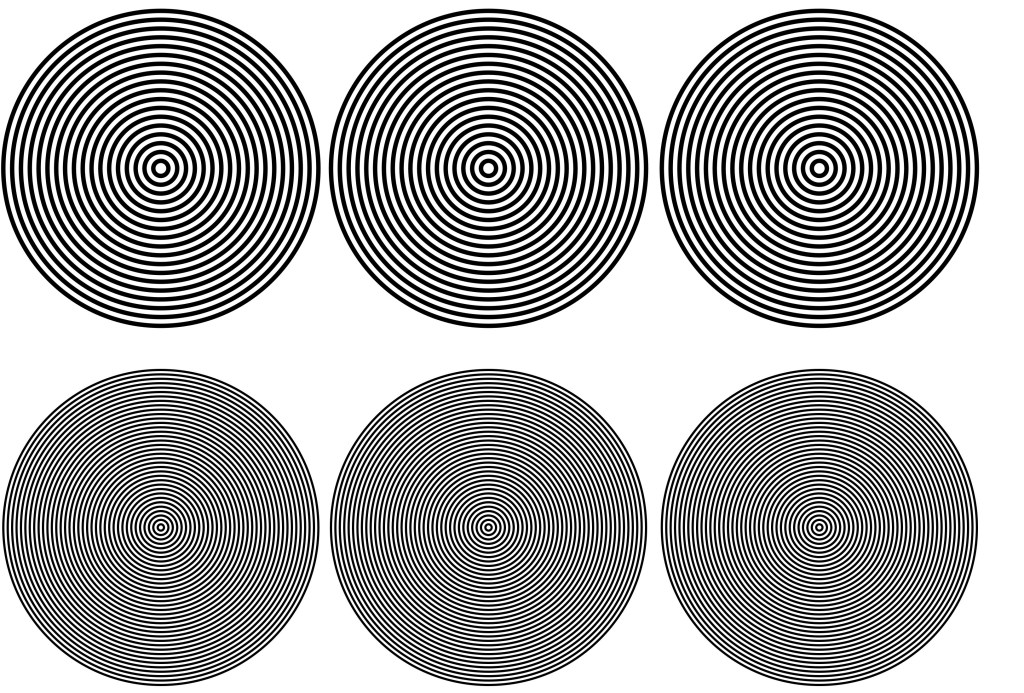
Your SWAG includes two sheets, one the usual plain paper and the other transparency film, with the figure above. You can cut these into three sets, each with two very fine bulls’ eyes. Lay the transparent sheet on top of the paper sheet and slide it around. What do you see? You can see similar patterns in puddles and is more expensive ripple tanks.
For instructors only after you have completed this scene click on SPOILER ALERT.
 Just Add Math