Observations
We begin with some simple but surprising observations using the three linear polarizing strips or filters in your SWAG that are shown below:
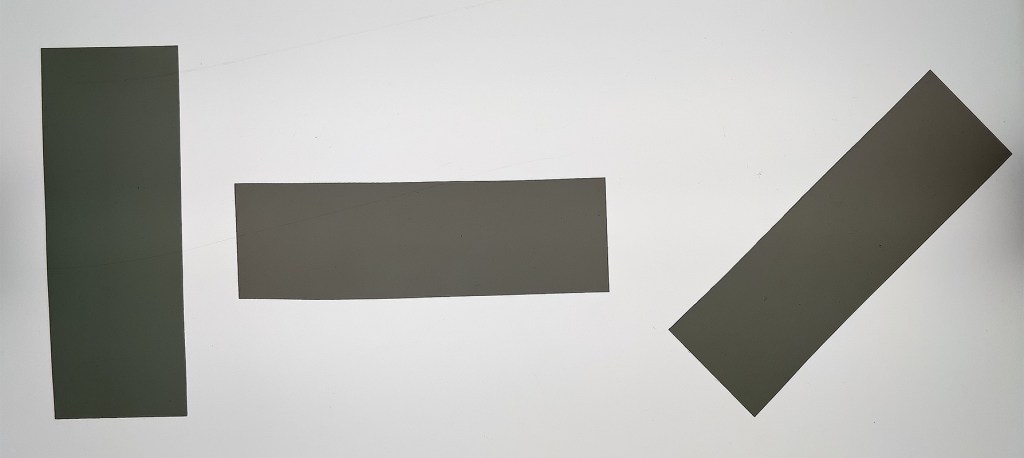
In the picture above these three strips are lying on top of a white light source. You may want to hold them up to a light source – perhaps a sheet of white paper taped to a window. These observations involve polarized light and some of the handiest light sources produce polarized light that will destroy these first observations. If your television or computer monitor uses an LED screen then it produces polarized light and is not usable for these first observations.
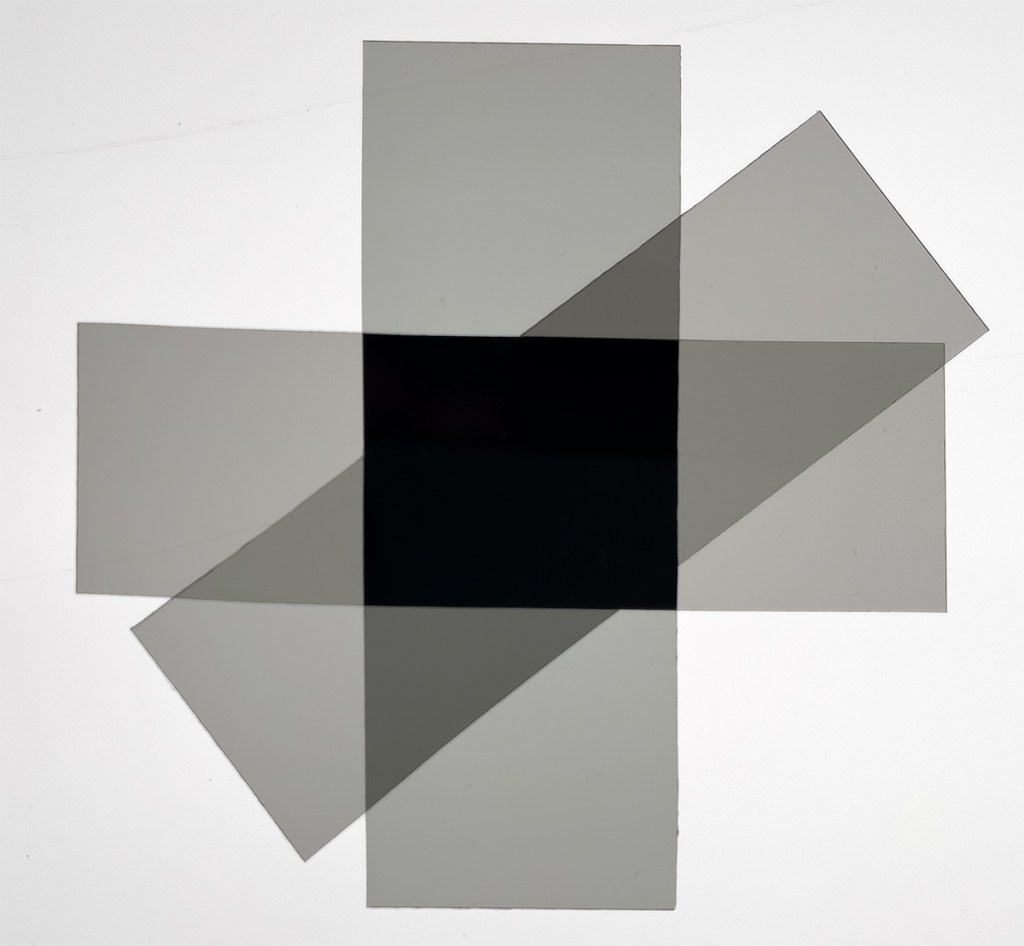
From left to right the three strips are oriented vertically, horizontally and obliquely at a 45 degree angle. In the picture below we made a sandwich using the vertical and horizontal strips.

Notice that no light gets through this sandwich. This is a good place for some experimentation. Try one sandwich with the vertical and oblique strips and another with the horizontal and oblique strips. What did you see? Try a sandwich with two strips and vary the angle between them. What do you see?
For the next experiment we add the oblique strip to the sandwich in the Figure 2, either on top of the sandwich or below the sandwich – outside the two layers of the starting sandwich. The result shown in the picture below is not surprising.
The next experiment, however, produces a surprising result. We add the oblique strip between the two strips in Figure 2.
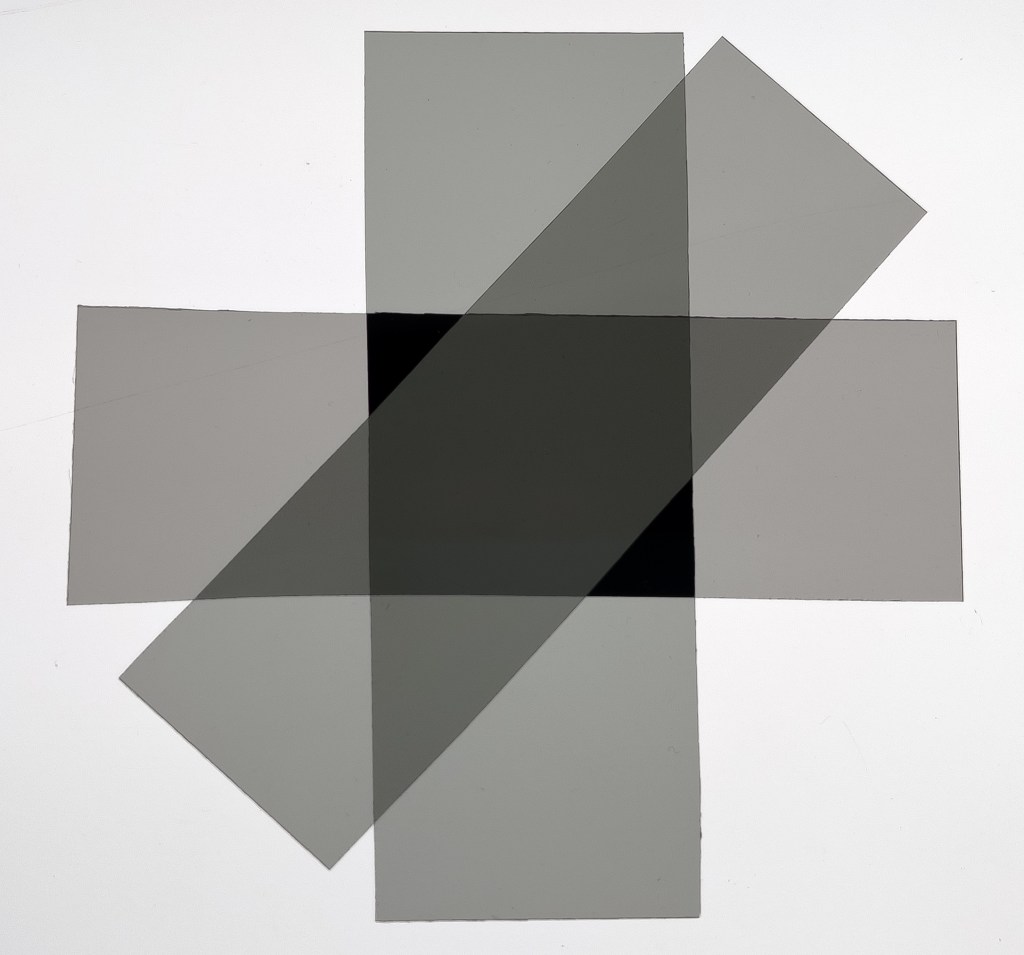
Now, we can see some light coming through the three-piece sandwich. The oblique linear polarizing filter actively did something to the light coming through the bottom filter so that some of it now passes through the top filter!!
This is a good time for additional experimentation. If your computer monitor or your television is an LED then try experiments using it as a light source.
The light that comes through a linearly polarized filter or that is produced by an LED monitor or television is polarized. Polarized light is found naturally all around you. For example, light that bounces off a reflective surface is polarized. Polaroid glasses use linearly polarized filters to eliminate or reduce glare.
Discussion
This is a very open-ended and incomplete discussion closing with more questions than answers. We need a way to model direction — perhaps with two dimensional vectors or complex numbers and we need an “active” model because of the way that order matters. This is the life of a scientist — always more questions and the need for further work.
This pdf provides a glimpse of further work on polarized light.
 Just Add Math